If still using SuperLab 6 or earlier, see this support note instead.
SuperLab 7 automatically saves all collected data in a folder that has the same name as your experiment followed by “data”. For example, if your experiment is named “Stroop.sl7”, then all data is saved in folder “Stroop data”.
Important: If you move the experiment file, always move the data folder with it. If you do not, SuperLab 7 will not be able to display the data and will create a new folder if you run the experiment again.
If you run an experiment in pilot mode, the data is saved into a folder named “Pilot” inside the data folder.
Within this data folder, SuperLab creates “session folders”. A session folder is added every time you run an experiment and contains one or more of the following items:
SuperLab saves the behavioral data in a plain text file with fields separated by tabs. This makes it easy to import into a spreadsheet or to write custom software to parse it. The file format produced consists of:
▪ A file header.
▪ A data header that describes the columns of data of data that follow.
▪ The actual data.
The file header and data header are always separated by a blank line.
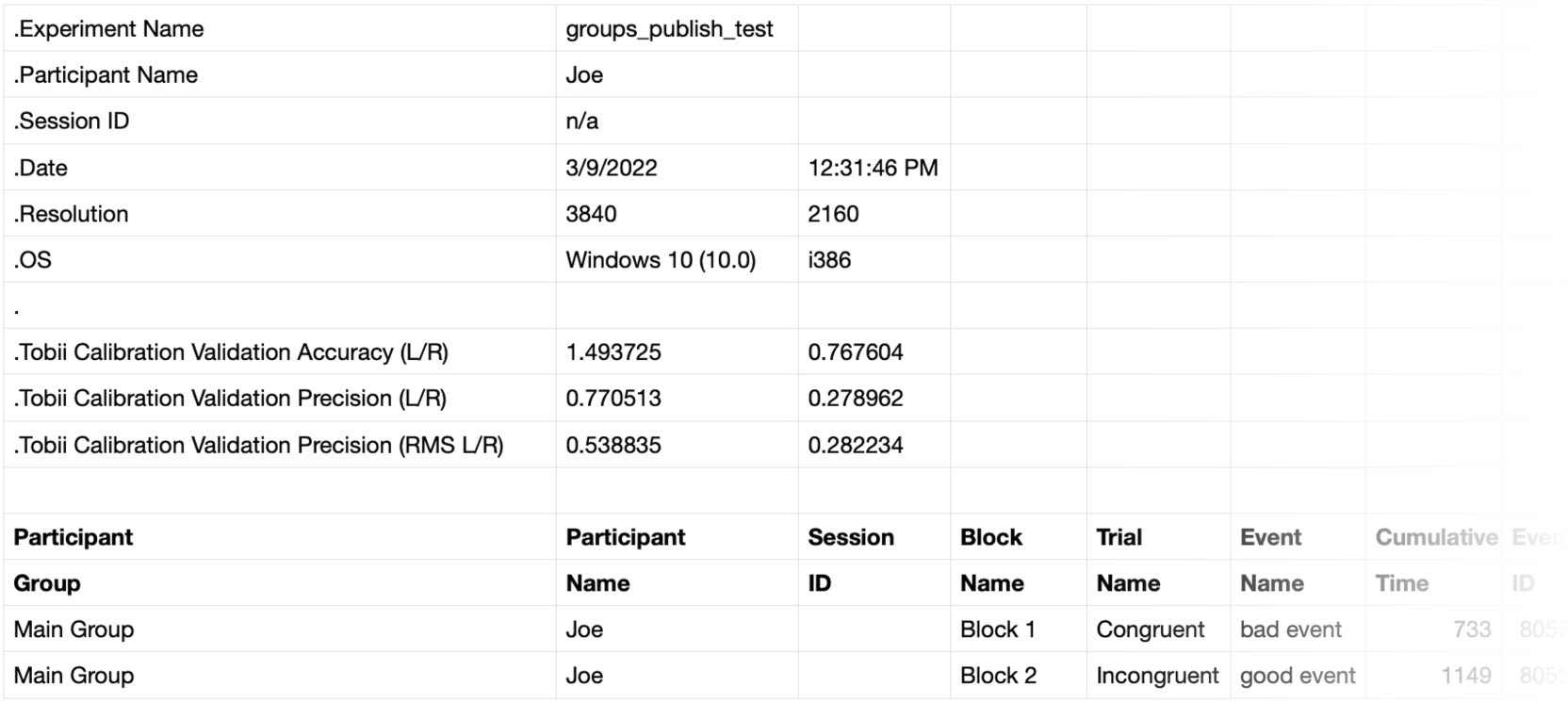
A line in the file header always starts with a period (dot) followed by a keyword. Here is description of all keywords:
▪ Experiment Name, followed by one field; this is the experiment’s file name.
▪ Participant Name, as entered when you run the experiment, or “n/a” if no name is entered.
▪ Session ID, as entered when you run the experiment, or “n/a” if none is entered.
▪ Date, followed by two fields to indicate the date and time.
▪ Resolution, followed by two fields to indicate the width (X) and height (Y) in pixels of the display.
▪ OS, followed by two fields that indicate the operating system and the processor (CPU).
The following keywords apply only to SuperLab X7 when using a Tobii eye tracker:
▪ Tobii Calibration Validation Accuracy (L/R)
▪ Tobii Calibration Validation Precision (L/R)
▪ Tobii Calibration Validation Precision (RMS L/R)
Please see the Tobii documentation for information on interpreting these numbers.
SuperLab adds one row of data for each participant response or expected response.
In addition to the standard data (Block Name, Reaction Time, etc.), a data file will contain the following additional columns:
Cedrus expects that more keywords will be added to the file header in future versions of SuperLab. If you are writing software to parse the data file, we suggest that your code not look for a fixed list of keywords. Instead:
▪ Look for a period at the beginning of each line.
▪ Get the keyword that follows the period. If your code does not recognize or care for the keyword, then simply ignore the rest of the line.
▪ If the next line does not start with a period, then you have finished parsing the file header.
This approach will make your code more future-proof regardless of how many new keywords get added to the file header.
Last Revision: Dec 17, 2025
File
Header
Data
Header
PRODUCTS
SUPPORT
STAY IN TOUCH


© Copyright 2026 Cedrus Corporation, P.O. Box 6309, San Pedro, CA 90734 - USA
Phone: +1-310-548-9595. Send us an email
qwerasdf